



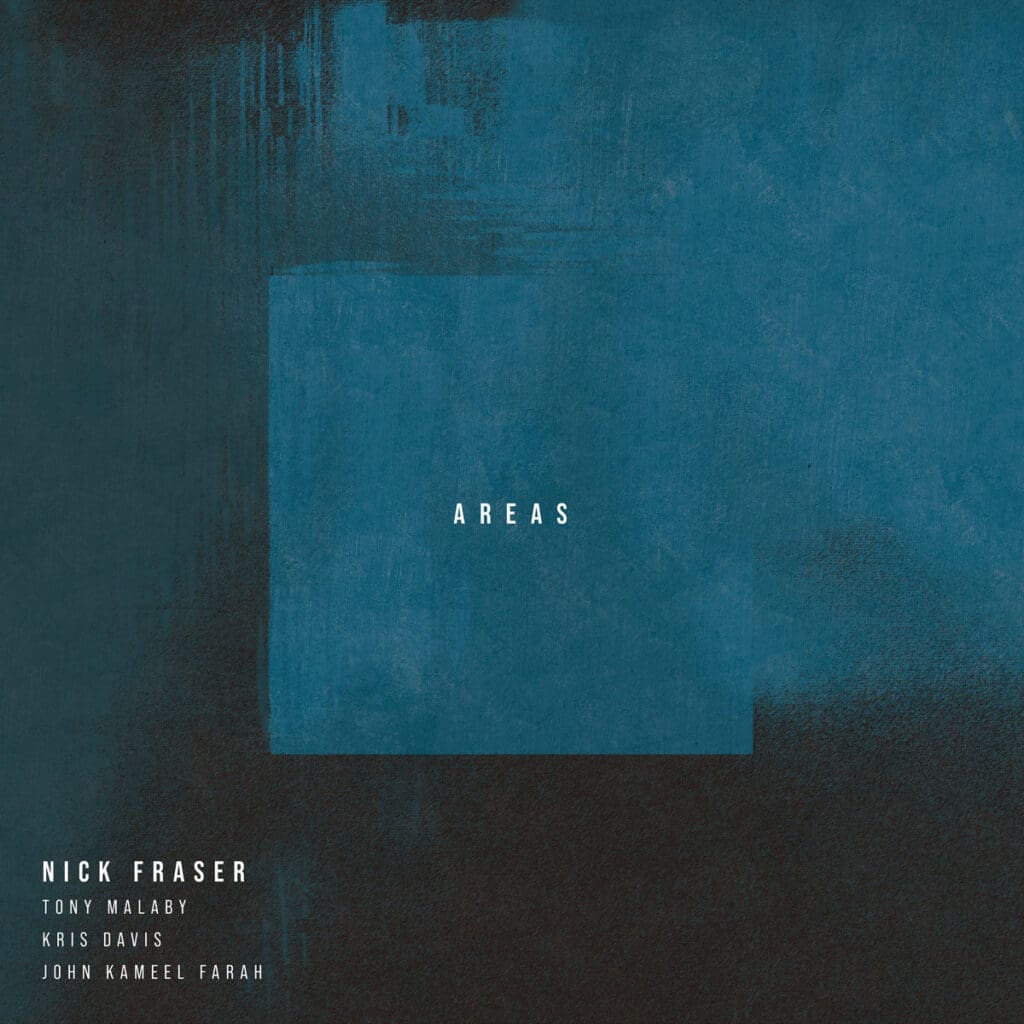
Nick Fraser: Drums, Piano Harp (1, 4, 7)
Tony Malaby: Saxophones
Kris Davis: Piano
John Kameel Farah: Electronics and Sound Processing (1, 4, 7)
Recorded @ Wellspring Sound, Acton MA
Mixed & mastered by Fedge
Art & design by Yesim Tosuner
Areas, the forthcoming recording of Nick Fraser sees Toronto-based composer and drummer returning to his trio, flanked by his acclaimed collaborators Tony Malaby (saxophones) and Kris Davis (piano). Following a 2015 debut on Clean Feed, Too Many Continents, their previous effort together was 2019’s Zoning (Astral Spirits), which featured special guests Ingrid Laubrock and Lina Allemano.
Here the intention to pursue something different is audible straight away. In fact, the very frst piece isn’t even credited to Fraser at all; instead, the haunted opener is one of three electroacoustic interludes crafted by renowned Palestinian-Canadian pianist and composer John Kameel Farah, derived from Fraser-Malaby duo exchanges.
As much as these eerie electronic pieces are offered as a sort of contrasting element throughout the record, starting out with one nonetheless sets the tone. WhereZoningunfurled a series of energetic free jazz tangles,Areas is characterized by a more atmospheric quality even if the playing often harnesses just as much energy and power.
“Mimic,” the frst Fraser-penned trio track opens with moody, partially-prepared piano lines from Davis enveloped in a haze of sizzle cymbal, which Fraser embellishes with other sporadic metallic punctuations. Malaby enters around the one and a half minute-mark with an elusive melody that faintly recalls Debussy’s “Syrinx” in both gesture and flute-like sonic hue—an attribute that belies the fact that his playing on this piece was left open by Fraser. Things soon start building as Malaby introduces gravelly multiphonics while Fraser and Davis establish an oblong groove. Ultimately it all unravels; everyone descends into their own flavour of hurried agitation. Where several tracks on the previous record plunged head-frst into tense, contrapuntal—almost argumentative—exchanges, here the band channels a swelling inevitability that might recall Lotte Anker’s Floating Islands, where she’s heard in her trio of the same instrumentation alongside Craig Taborn and Gerald Cleaver.
The start of the 11-minute “Area” signals the band returning to quieter dynamics with Malaby’s husky cantabile supported by Fraser and Davis’ rapid scurryings across their instruments. There’s a shift away from this shadowy abstraction in the third minute as Davis begins to anchor her glassy, upper-register scuttling with left-hand chords that grow in intensity. Her ever-more assertive chording propels Fraser and Malaby to follow her and together they coalesce—albeit temporarily—into a strange, flustered vision of legato post-Coltrane free jazz. But then Malaby and Fraser recede, leaving Davis hammering chords at full intensity and rhythmic acuteness. Fraser begins hurling bold unusual colours on top and in between these sturdy bricks of piano sonority and before long Malaby swoops in with a barrage of feverish, animalistic braying, pushing the band toward another culmination point. Following this delirious climax, they return to a space that matches the opening’s tone and decibel level, channeling the prior restlessness into an otherworldly ballad feel.
Side B is bookended with the two other Farah-sculpted miniatures. The aptly-named “Howling Circuits” twists and kneads Malaby’s overtone-laced saxophone into a bionic choir, interleaving all manner of expansive moans with otherworldly peeps, as Fraser’s piano harp percussion provides occasional accents. On “Brood,” which closes the record, it’s the inverse—insistent string-gongs sit in the foreground as mangled flocks of Malaby’s cries circle in the distance.
“There Are Other Ways” presents another scenario where Malaby’s freeform playing is juxtaposed with composed material in theremaining ensemble. It’s also arguably the record’s fercest cut. Beginning with a saxophone solo, soon Davis and Fraser drop brawny slabs of piano and drum wallop underneath him, sporadically pausing to give him space to squeal, click or hurtle through a torrent of smeared notes. Following their longest break, things become utterly relentless with drums and (especially) piano pounding stubbornly as Malaby’s horn unleashes anguished shrieks and slippery, crowing melodies. Fraser relays that the piece serves as a tribute to the duo project of his longtime collaborator Brodie West, Ways alongside drummer Evan Cartwright. There are indeed shared affnities with Ways’ spartan angularity, but West and Cartwright seldom venture into the bluntness and heft witnessed here.
The penultimate “Sketch 57” is another long piece, one that Fraser describes as “a dissonant chorale that devolves into a gently swinging dirge.” Devolves is the keyword here, on account of the gradual temporality it implies. This is the trio at their most patient, allowing the music to expand slowly and organically.
Areas beautifully documents the development ofNick Fraser’s compositional vision as well as the unique musical interplay of this powerful trio. Nestled within John Kameel Farah’s beautifully elliptical segues, this new body of work reveals new sonic and affective depths encompassed within this group.